Walking
We all do it. It’s a thing learned without learning – a thing over which we all claim mastery. We step left over right without a moment’s hesitation down sidewalks and across busy streets, weaving our way like an erratic stitch through the pedestrian fabric.
Sounds easy, right?
But the fact remains: most of us don’t really know how to walk. We collide with each other on a routine basis, swinging our bags like weapons in combat. We spill coffee on clean clothing. We lose children.
We learn how to walk in our infancy, and over the next 70-80 years – as our minds crowd with meaningless song lyrics and the ramifications of health care reform – we gradually forget how to walk. We are reduced once more to cruising. And shuffling.
Here then is a quick refresher.
Walking is easy – so don’t be intimidated. According to the definition I just made up, walking is “bipedal forward progress” keeping one foot on the ground for support at all times. Unless you are a recent descendant of an ape, hands should not contact the floor. If both feet stay on the ground, this is called “shuffling.” If no feet stay on the ground, then this could be any variation of air travel from hopping and skipping to falling from a cliff.
But this would not be walking.
The key to successful walking lies in the alternating movement of your right and left legs: for example, left right left right – or right left right left. You may start with either foot, it really doesn’t matter (see Figure 1).
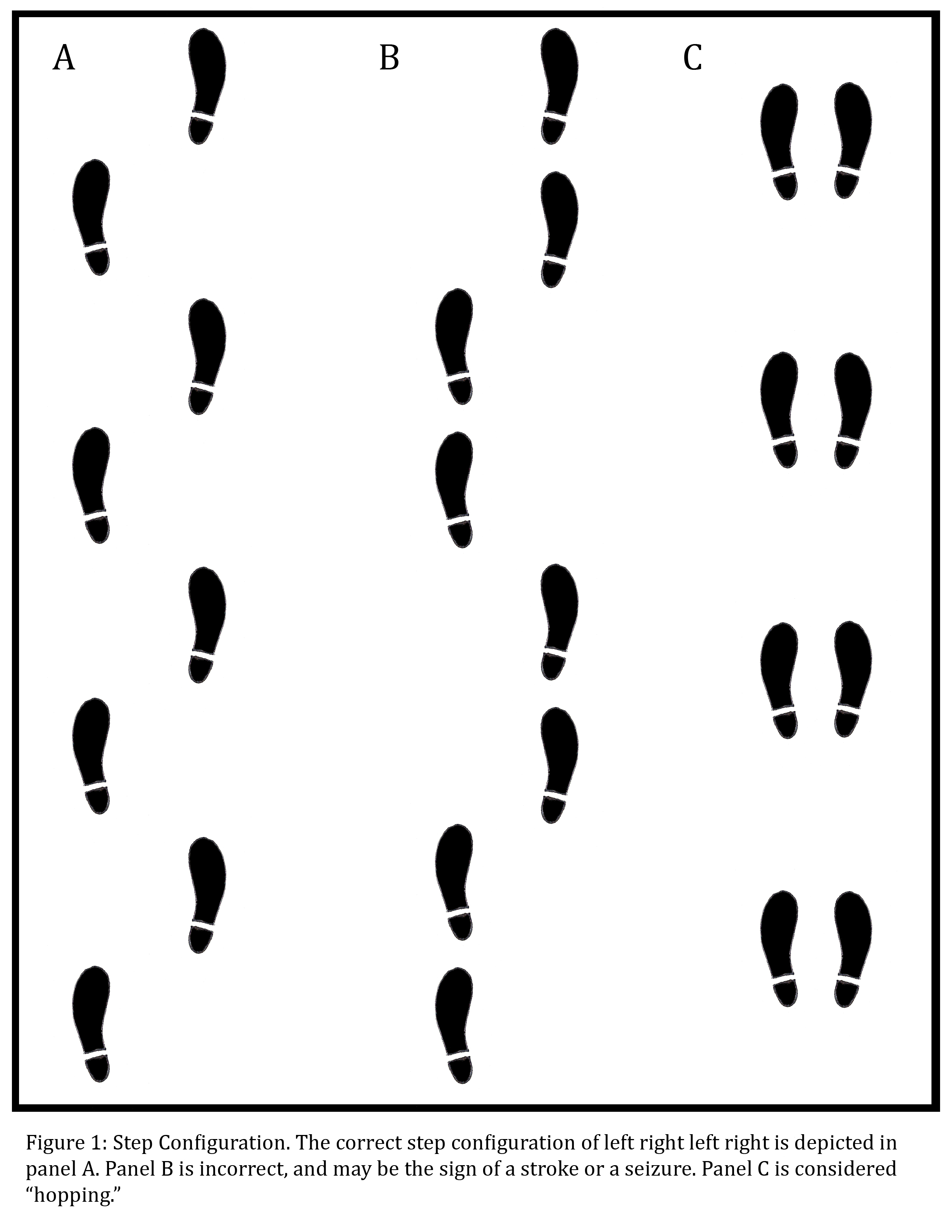
The step itself requires you to push into and against the ground – if you only push into the ground, then you’ll find yourself doing a one-legged squat. And while this may serve to significantly strengthen your thighs, it will do nothing for your forward progress.
Now if you are an observant toddler attempting this for the first time – or have walked before – then you’ll notice that your arms start swinging back and forth as you step, almost instinctively and without prompting. The arm typically swings at the same time that the opposite leg steps – for example: right arm swings as left leg steps, etc. If both arms swing forward at the same time, then this is known as “shooing away.” If both arms swing backward at the same time, then this is probably some form of modern dance and you should stop immediately.
Why exactly does the arm swing exist, you ask? I don’t know.
But traditional limb-girdle theory suggests that the arm swing is an evolutionary development to counter–balance the step, and in so doing prevents tilting or the appearance of public intoxication. However, a group of revolutionary ambulatologists out of Akron, Ohio have suggested a different explanation.
With the invention of trousers, a seismic spike in arm swinging was noted in the walking literature. The “Akron Swinging Five” (as they were unfortunately christened) theorized that the active arm swing served more as a protector of pocket content and less as a primitive counterbalance. As if to confirm this theory, the National Pickpocket Association reported a sharp decline in pockets picked shortly after the above surge in arm swinging.
But regardless of theory, the arm swing is a necessary aspect of modern walk and should not be discouraged, even on principle. And when combined with the step, it makes for one amazingly effective mode of transportation.
So there you have it – the basic mechanics of walk. We can discuss more advanced walking techniques at a later time – but for now, this should keep you on your feet.
**One final point – always walk with your eyes open. This seems intuitive but is a very common mistake. Blinking doesn’t count, and is in fact encouraged – a lack of blinking may lead to corneal abrasion, dryness, and any number of medical misdiagnoses**
 One Man's Guide To...