The Head-On Collision
Anyone who has been walking for any period of time knows that the head-on collision is one of the most awkward and confusing oddities in the history of walk. In recent memory no fewer than five volumes of text have been written about the subject: the head-on collision has been studied as social commentary and used as political platform, and the concept is enjoying renewed scrutiny in the field of psychoanalysis.
The head-on collision is, of course, exactly as it sounds: two people walking toward each other suddenly realize – usually at the same time and from several feet apart – that they are about to collide head-on.
What happens next is perhaps the greatest universal quirk of mankind – a thing that I am sure alien life will study and mock relentlessly when the footage is reviewed.
Instead of separating or walking away, both parties meet in the middle and engage in an awkward, shifting dance of sorts – an urban tango, if you will. Eyes meet, breath is held – they stagger one way and then stagger the other, mimicking each other’s steps like a Harpo mirror act. Then they pause, chuckle, point in one direction and finally untangle – but at what cost?
If you believe Dr. Sam Stafford’s article in the recent March 2009 issue of the American Journal of the Very Old and Frail Accepting Only Articles with Questionable Statistics, the cost is not negligible:
“In 2007 alone there were an estimated 432,987 walking related injuries in the United States. Of these, approximately 157,112 were related to head-on collisions (either averted or completed). The majority of these injuries were psychological in nature, but a significant number involved pulled hamstring or gastrocnemius muscles. No fewer than 57 broken hips were reported from associated falls. This resulted in a cost burden of 500 million dollars or less on the healthcare system.”
Why all this needless and costly confusion? The reason is that people tend to over-analyze the situation:
Which direction is he going to turn? He seems to be leaning left – then I will go right. No wait, then I will go left. Maybe I will just keep walking straight and he’ll get out of the way… should I point which way I’m going? No… no, I’ll go left.
The result is – understandably – a mess. How then do we avert these potential disasters? The solution is quite simple, and perfectly elegant: when you realize that a head-on collision is imminent, always move to the right. If you move to your right, and the other person moves to his right, then the collision is averted (see Figure 1).
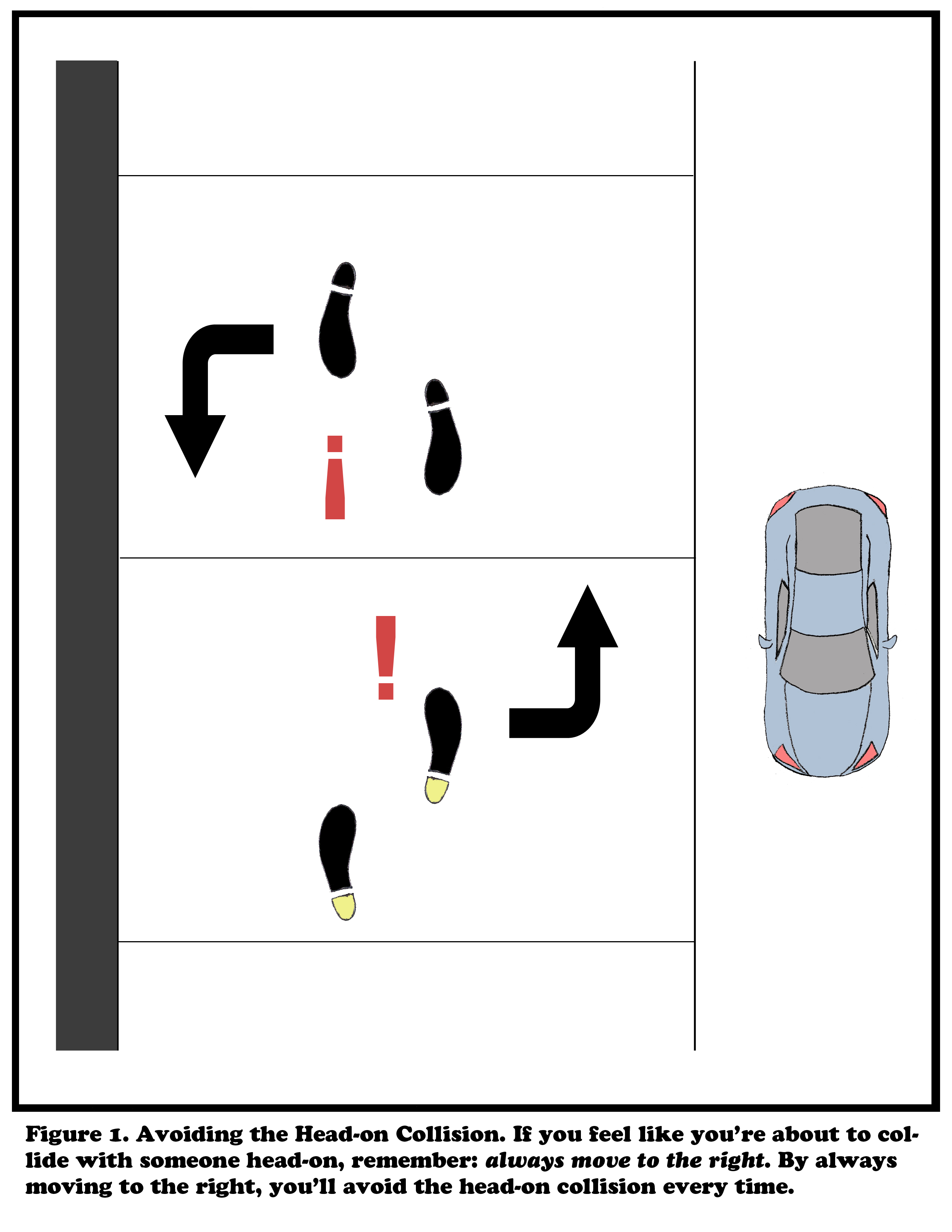
This concept applies specifically to the culture of right-sided travel found in many western nations. In this setting, moving to the left makes little sense as it could throw you into a subsequent head-on collision with a second individual walking in the same direction as the first.
Study the above diagram carefully – or print it out and carry it with you for quick reference, or tattoo it on your palm. Remembering and applying this concept will save you valuable time, and prevent a potentially awkward and psychologically devastating display of rhythm… or lack thereof.
 One Man's Guide To...