 by
by Now that you’ve selected and bought your bottle of wine, what exactly do you plan to do with it? Don’t limit yourself to convention or common practice – there are, to date, no fewer than 1,458 accepted uses for a wine bottle. You could, for example, use it as a paperweight. Or as a weapon. Or you could place it on the floor of an empty room and call it modern art – a testament, if you will, to how a gaping emptiness is all too easily but incompletely filled by the dependence on object and substance, and not on human connection.
But if you are comforted by convention, then perhaps the most common thing to do with a bottle of wine is to open the bottle and drink the wine. If you’ve never opened a bottle of wine before, this step could be just as intimidating and challenging as buying the wine itself – particularly because it involves instrumentation (see Figure 1).
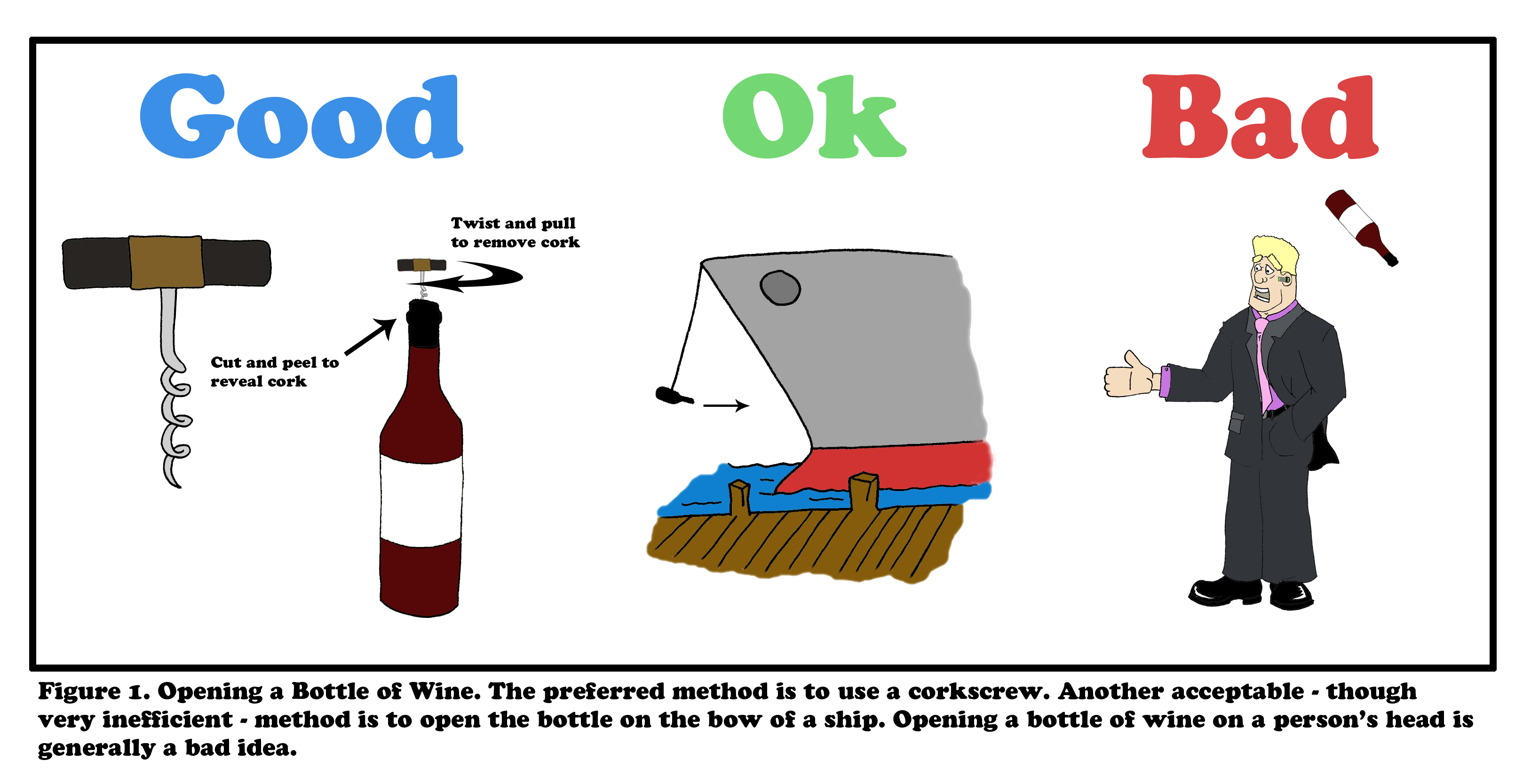
The corkscrew is the preferred method for opening a bottle of wine, and is very safe to use – if used on the cork and not on the flesh or a semi-viscous organ like the eye. This method is not without its complications, however – if the wine is of an older vintage or the cork poorly constructed, there is the risk of “splitting the cork” which could make the bottle very difficult to open, or sprinkle bits of cork into the wine below. This could be a source of great embarrassment and emasculation. Trevor Dyllan, in his memoir Why I Can’t Have Nice Things, wrote of his experience at a Manhattan rooftop party:
“And then the cork shattered. Into a thousand pieces, like I’d shot it with a pistol. I was devastated, everyone was laughing and pointing… they just wouldn’t stop. Everywhere I went people knew me as that guy – Trevor Dyllan, the guy who split the cork. I… I’ve never really recovered from that. I think it has something to do with my trust issues, or my mother…”
He goes on and on for several pages and it’s really not a very good memoir, but the point is this: people have been opening wine for hundreds of years and it’s still a challenging endeavor. Don’t be afraid to ask for help.
Once you’ve opened the bottle of wine, the drinking is quite easy. But here again you have several options (see Figure 2) – some preferred and some quite dangerous. As you can see, the preferred method of drinking a bottle of wine is to divide the wine into any number of wine glasses. The wine glass is held – typically in your dominant hand – and almost always by the stem: this is particularly relevant if you are drinking a chilled white wine or champagne, as gripping the glass itself will raise the temperature of the wine. Depending on the company you keep or your individual inclination, you may either tuck or elevate your pinky finger – but pick one and stay consistent: excessive contortion of the holding hand may be seen as a sign of mental instability or seizure.
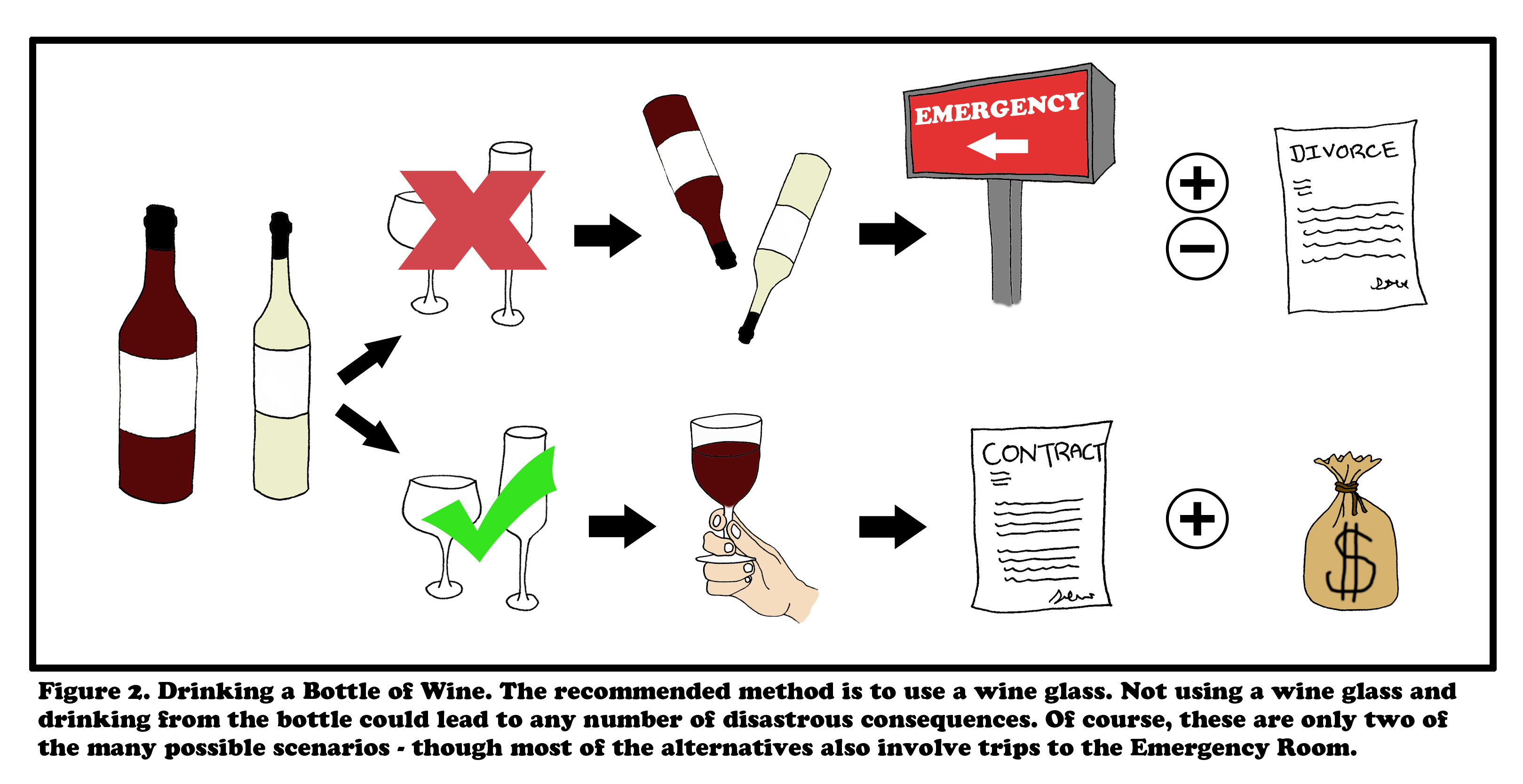
Once the glass is full of wine, raise it to your lips and drink. Try to avoid splashing the wine in your face as this is not the right way to drink a beverage. If the wine is bitter or disagreeable, then spit it out and grab something else. If the person who brought the wine is staring at you and awaiting your approval, then you have several options. Perhaps the most tactful approach is to swallow the wine and say something to the effect of “what an interesting combination of flavors” or “it is full of such subtle undertones.” These comments are intentionally ambiguous and will give the impression of a discerning palate. If you simply can’t bring yourself to do the above, then you could spit the wine out or let it dribble slowly from the corner of your mouth with a vacant look on your face (these methods work well if you don’t care for the person).
The safest method, however, is as follows: don’t say anything after your first sip – instead, go in for another sip, and when the wine glass is at your lips, quickly push the first sip back into the glass. This gives the impression of genuine interest and gratitude with minimal offense to both the other person and your tongue. Saying something like “what an experience” often completes the illusion.
 One Man's Guide To...
I can testify to the fact how thoroughly traumatizing splitting a cord can be. Problem with me when that happens is the urge to smash the bottle immediately to get the little cork bits out.